UK Business AI Adoption Statistics: Sources, Definitions and Downloadable Data
By M Shiraz, NexaCore House | Research checked 6 October 2026
This resource brings together selected official UK business AI findings published in 2026. The underlying survey periods differ. Figures below describe those periods and should not be treated as a measurement of adoption in October 2026.
What percentage of UK businesses use AI?
ONS reported 29% across the business population covered by its June 2026 survey. Its separate analysis reported 34.9% for businesses with 10 or more employees. DSIT reported 16% from a survey conducted in February–May 2025 among private-sector businesses with at least five employees in its covered sectors. These are different populations and periods, rather than interchangeable answers. [1–3]
For a business owner, the useful question is which estimate matches the comparison you want to make. For a writer, the essential task is to keep the population and fieldwork date attached to the percentage. A short headline can otherwise imply a much broader claim than the research supports.
UK AI adoption statistics: source comparison
| Finding | Population | Fieldwork | Source |
| 29% using at least one AI technology | BICS business population; survey coverage applies | 15–28 June 2026 | ONS bulletin [1] |
| 34.9% using at least one AI technology | Businesses with 10+ employees | 15–28 June 2026 | ONS Figure 1 [2] |
| 16% using at least one AI technology | UK private-sector businesses with 5+ employees in covered sectors | 12 February–2 May 2025 | DSIT research [3] |
“BICS business population” means the businesses represented by the Business Insights and Conditions Survey. It should not be interpreted as every organisation in the UK. See the original publication’s coverage and quality notes. [1]
AI adoption among businesses with 10 or more employees
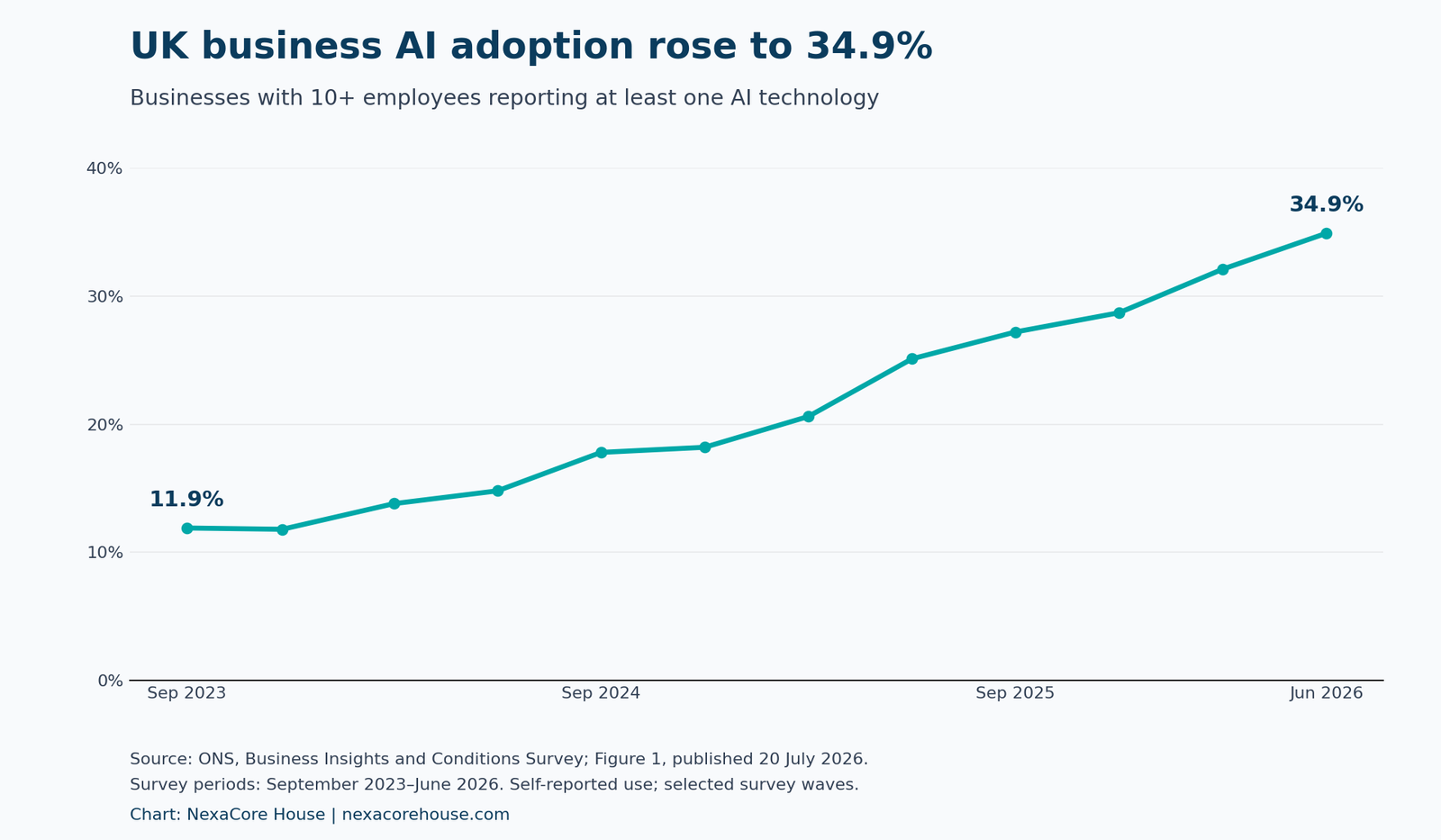
The downloaded ONS Figure 1 data contains 12 observations. Reported adoption increased from 11.9% in September 2023 to 34.9% in June 2026: a rise of 23 percentage points, with the final rate approximately 2.93 times the initial rate. These calculations use the published, rounded values. [2]
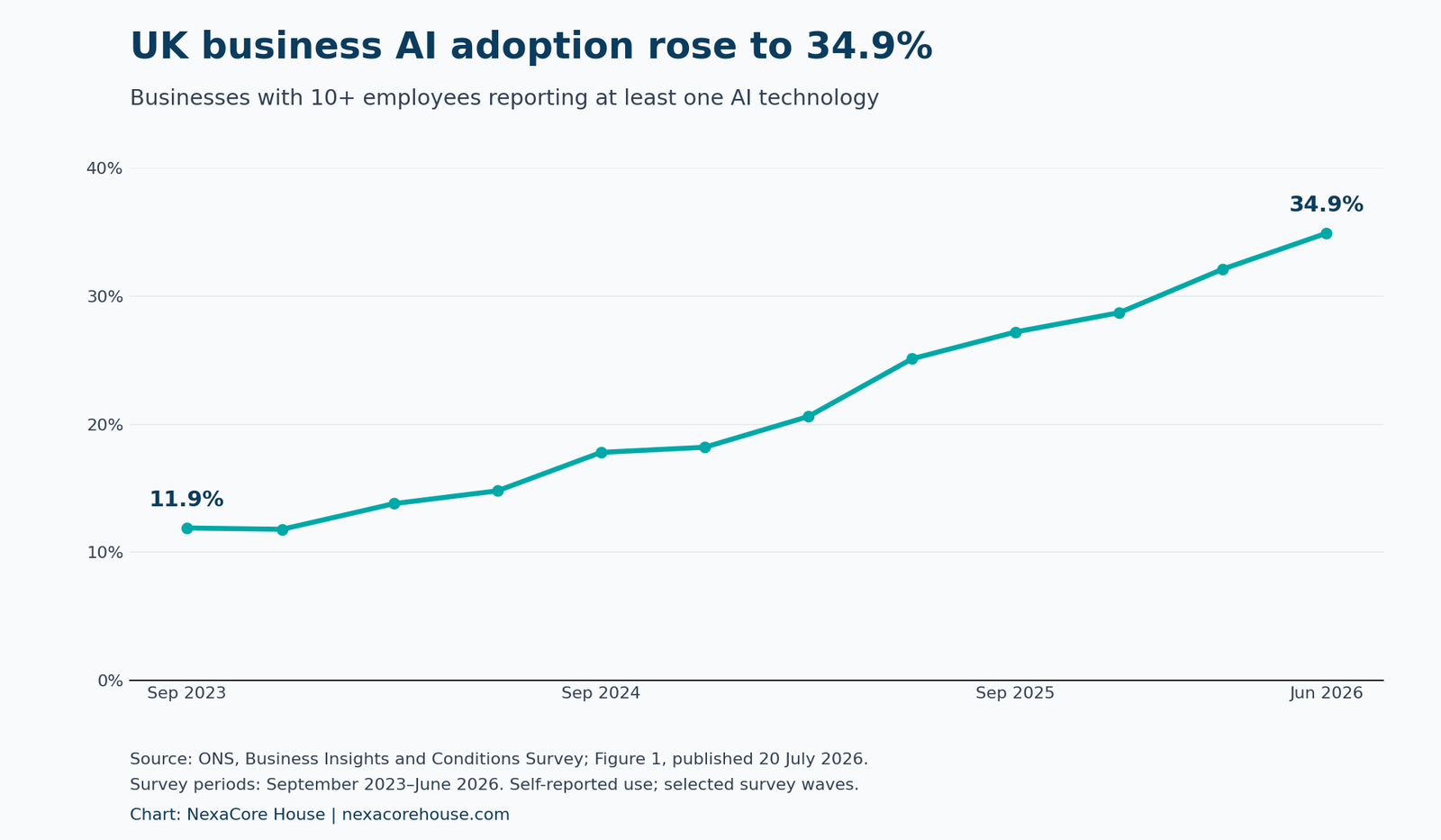
Figure: Selected ONS survey waves, September 2023–June 2026. Businesses with 10+ employees. Source: ONS BICS; chart prepared by NexaCore House.
View or download the chart (PNG)
Source data: Office for National Statistics. Chart prepared by NexaCore House. Covers businesses with 10 or more employees, September 2023–June 2026.
| Survey period | Reported AI use |
| 18 September 2023 to 1 October 2023 | 11.9% |
| 11 December 2023 to 24 December 2023 | 11.8% |
| 18 March 2024 to 31 March 2024 | 13.8% |
| 17 June 2024 to 30 June 2024 | 14.8% |
| 16 September 2024 to 29 September 2024 | 17.8% |
| 16 December 2024 to 29 December 2024 | 18.2% |
| 17 March 2025 to 30 March 2025 | 20.6% |
| 16 June 2025 to 29 June 2025 | 25.1% |
| 15 September 2025 to 28 September 2025 | 27.2% |
| 15 December 2025 to 28 December 2025 | 28.7% |
| 16 March 2026 to 29 March 2026 | 32.1% |
| 15 June 2026 to 28 June 2026 | 34.9% |
Why the figures differ
Three checks make a comparison more reliable. First, identify who was included: businesses, employees or adults, and which size bands and sectors. Second, distinguish fieldwork dates from publication dates. Third, examine whether the question concerned any AI technology, a particular tool or a specific business activity.
ONS and DSIT use different survey designs. The DSIT research involved 3,500 telephone interviews with technology-responsible respondents; it notes that this approach does not capture shadow AI adoption. [3] This is a reason to read the methods, not a basis for deciding that one percentage is universally correct.
Do not join the DSIT and ONS headline figures into a single growth line. A difference between surveys cannot establish how much adoption changed. Our trend chart instead stays within the published ONS Figure 1 series.
Adoption and business value are separate questions
A business can report using AI without having demonstrated a financial return. DSIT found that 77% of AI-using businesses reported no revenue change since adoption. This is self-reported evidence from its 2025 fieldwork, not a finding that AI cannot produce value. [3]
Our consulting interpretation is that adoption statistics are useful context, while investment decisions need workflow-level evidence. Start with one task: establish the time it takes, how often it occurs, the review effort required and the quality of the result. Then compare those measures after a controlled pilot.
For reporting workflows, include time spent correcting errors and checking outputs. A faster first draft does not necessarily mean a faster completed report. Record software costs and human review time alongside any time saved. This approach gives management a practical basis for deciding whether to expand a pilot.
How to use and cite this resource
When quoting a figure, include the original source, fieldwork period and business population. Credit ONS or DSIT for their research. NexaCore House provides the compilation, chart and explanatory analysis; we did not conduct these surveys.
Suggested chart attribution: “Chart by NexaCore House, using ONS Business Insights and Conditions Survey data, September 2023–June 2026; businesses with 10 or more employees.” Link to this research page and the original ONS publication so readers can inspect both.
Methodology and limitations
We checked the figures against the official publications and the supplied ONS Figure 1 CSV. The comparison table preserves distinct survey populations and periods. Percentages are estimates; the source publications explain their sampling, weighting and limitations. Calculations based on rounded values are approximate.
This first edition does not include a complete business-size or industry breakdown. No missing values have been inferred. It is a selected evidence resource, not a comprehensive inventory of every UK AI survey, and it does not claim the June figures are the latest available across all releases.
Sources
[1] ONS — Business insights and impact on the UK economy, 2 July 2026
[3] DSIT — AI Adoption Research, updated 13 February 2026
Update log
12 October 2026: First edition published, including an ONS AI adoption trend chart, source comparison table and methodology notes.